


美国《时代》杂志近日刊发华为轮值董事长徐直军的署名文章《走进华为的创新之旅:看见、亲历、引领》,讲述其1993年入职华为以来三十多年的创新历程:从程控交换机起步,历经IPD变革、分布式基站与SingleRAN,到2012实验室孵化5G、自动驾驶与昇腾。
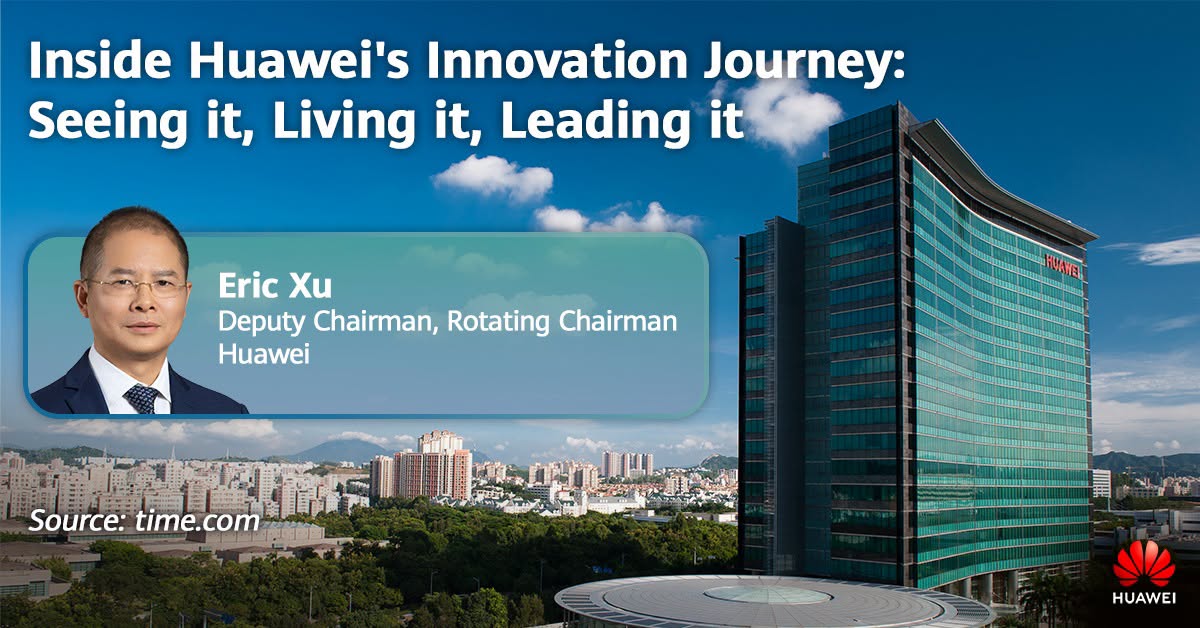
徐直军在文章中回忆,1993年5月,博士即将毕业的他在《深圳特区报》上被华为的整版招聘广告吸引——广告特别写明招收硕士和博士,这在当时的深圳并不多见。出于好奇前去面试后,华为人力资源经理每周电话相邀、承诺薪水为其博士生导师的五倍,他最终选择入职。同年8月入职时,这家公司600名员工中有200多人为研发工程师,当年入职的博士就有5位。
其时华为研发团队正在开发数字程控交换机。西方厂商的交换机每线价格约3000元人民币,华为推出通过光纤连接的远端交换模块,用一套集中式系统即可覆盖整个县,每线价格约1000元,利润率超过20%。1993年至2002年,华为员工增长至22000人,其中研发工程师超过1万人,收入逼近40亿美元。
2002年,徐直军被安排负责“集成产品开发(IPD)”变革项目。IPD是华为创始人任正非在1997年走访美国科技公司后提出的构想,华为为此请来IBM担任顾问,变革于1999年启动,徐直军自2002年起与IBM顾问共同推动流程推广至整个研发体系;1997年至2006年,华为向IBM支付了近6亿美元咨询费。徐直军称,IPD重塑了华为的研发结构,使其能够稳定交付满足客户需求的高质量产品,支撑研发队伍从1万人增长至今天的11万人。
2003年,徐直军出任无线产品线总裁。由于中国一再推迟发放3G牌照,华为被迫拓展海外市场。余承东在与荷兰运营商Telfort的交流中提出将基站拆分为两部分的分布式基站方案;此后华为又与沃达丰合作推出将2G、3G、4G、5G集成到同一基站的SingleRAN,两者先后成为业界标准形态,确立了华为在移动通信领域的全球领先地位。2011年,华为整合研究团队成立2012实验室,作为持续创新的投入平台,5G、自动驾驶和昇腾均在此孵化;华为2009年即启动5G研究,现已成为5G标准的主要贡献者和全球最大的5G专利持有者之一。
徐直军在文章中表示,华为对人才的承诺背后是利益分享机制,几乎所有符合条件的员工都持有公司股权;华为每年将收入的10%以上投入研发,2007年至2025年累计研发投入超过1.8万亿元人民币,目前已获得授权专利24.5万件。
以下为文章原文(中文译文仅供参考):
《走进华为的创新之旅:看见、亲历、引领》
1993年5月,我博士学业即将结束,去深圳找工作。在朋友家里,我随手翻看《深圳特区报》,一则华为的整版招聘广告一下子吸引了我。广告上特别写明,要招硕士和博士。这有点反常。作为中国改革开放的前沿,深圳当时是加工贸易的聚集地,很少有企业招高学历人才。出于好奇,第二天我就去面试了,结果拿到了录用通知。
临近毕业,我手里已经有好几个Offer,但华为的那份与众不同。他们的HR经理每周都给我打电话,说一切都准备好了,就等着我过去。这份尊重、这种急切,再加上承诺的薪水是我博士生导师的五倍,让选择变得毫无悬念。我选择了华为。
8月入职后我才发现,公司600名员工中,有200多人是研发工程师,还有一大批研究生。同年入职的博士就有五位。这在中国任何地方都难以想象,深圳尤其如此,因为当时全国每年毕业的博士也只有约2000人。华为在创业初期就在人才上下如此重注,清楚表明了它对创新的执着和面向未来的投入。
当时,研发团队正在做数字程控交换机。随着中国经济高速增长,家庭和办公电话的需求远远超过供给。有好些年,装一部电话既难又贵。西方厂商的交换机在中国也能买到,但标准五花八门、互不兼容,每线价格约3000元人民币。这在当时是一笔巨款。
这里就藏着机会。当时,中心城市周边散布着大量地理上分散的乡镇和村庄。每个点都建一套完整的交换机,在经济上不划算;用铜缆连接偏远地区,成本高昂,还容易衰减信号。于是我们做出了光纤连接的远端交换模块,用一套集中式系统就能为整个县提供网络覆盖。
客户很喜欢这个方案。我们就是这样在与西方老牌厂商的正面竞争中快速做大了业务,而这些厂商无一例外都与我们的客户建有合资企业。我们的产品更便宜,每线大约1000元,利润率还超过20%。这支撑了华为的快速增长,也给了我们急需的现金流。短短十年间(1993—2002),员工人数增长到22000人,其中研发工程师超过1万人,收入逼近40亿美元。
许多美国领先企业都是从小做起的。它们靠自己闯荡,一步一步摸索前行,靠卖产品赚钱,再把赚来的钱投回研发。就是那种"自力更生、白手起家"的精神。华为也是如此。
2002年,我意外地被安排负责一项名为"集成产品开发(IPD)"的重大变革项目。2005年,我被任命为投资评审委员会(IRB)主任,负责审视公司所有的产品投资。2011年我出任轮值CEO时,才卸下与IPD相关的职责,但直到现在,我仍然投入大量时间让IPD与时俱进,并推动华为的业务发展。
IPD改变了我们开发产品和做研发投资决策的游戏规则,也完全重塑了我们的研发结构。变革之前,我们在研发上的成功高度依赖个别特别能干的个人,能否做出高质量的产品带有很大的偶然性。IPD变革为我们建立起一套体系,使我们能够稳定地交付满足客户需求、有竞争力的高质量产品。
IPD是我们创始人任正非的构想。1997年,他走访了几家美国科技公司,深受它们产品开发方式的启发。访问归来后,他请来IBM担任顾问,帮助我们设计和实施一场全面变革,覆盖研发投资决策流程、组织和文化。
变革于1999年启动。起初我只是众多参与者之一,直到2002年,我被委以主导权,与IBM顾问并肩推动变革,把IPD流程推广到整个研发体系。
十年间,我们建立了更高效的研发投资决策流程、集成产品开发流程,以及相应的组织架构、能力和IT系统——统称为IPD管理体系。正是这套体系,让我们不仅能管理一支不断壮大的研发队伍(从1万人增长到今天的11万人),还能持续交付满足客户不断变化需求的创新产品。
1997年到2006年,华为向IBM支付了近6亿美元的咨询费。这很可能是中国历史上规模最大的单笔企业咨询项目。
2003年,我被任命为无线产品线总裁。当时这个部门只有2000多人,正在做3G产品。我的使命,是让华为从固定网络设备供应商,转变为同时提供固定和移动网络设备的供应商。由于中国一再推迟发放3G牌照,我们被迫到海外拓展市场。
当时,余承东负责WCDMA产品,这是支撑3G网络的主要技术之一。与荷兰运营商Telfort一起查看基站机房时,他发现欧洲的站点获取成本高得惊人,而且根本没有空间再新建基站。他从欧洲打电话给我,商量能不能把基站拆成两部分:一部分装在铁塔上,另一部分装进一个小盒子,可以塞进现有基站的机柜里。我们都觉得这个方案可行,于是决定做分布式基站。
这个方案遭到许多运营商和设备商的抵触,但最终成为今天3G、4G、5G基站的标准形态。余承东还在与西班牙电信德国公司(Telefónica Germany)的一次讨论中提出,把2G和3G集成到一个基站里。后来,我们与沃达丰合作推出了SingleRAN,把2G、3G、4G、5G在物理上集成到同一个基站中。这同样成为全球基站的事实标准。分布式基站和SingleRAN这两个开创性方案,确立了华为在移动通信领域的全球领先地位。
为了在即将到来的数字信息洪流中找到我们的"诺亚方舟",我们加强了基础研究。2011年,我们把公司的研究团队整合为一个新组织——2012实验室,名字取自电影《2012》。它将作为持续创新投入的平台,涵盖基础研究、核心技术和工程能力。与此同时,我们改变了研发投入模式:2012实验室的资金一部分来自公司,其余来自各业务单元。从成立第一天起,我就一直在塑造这个实验室的组织、团队、能力和面向未来的研究项目。5G、自动驾驶和昇腾,都是在这里孵化出来的。
我们早在2009年就启动了5G研究,最终成为5G标准的主要贡献者和全球最大的5G专利持有者之一,巩固了华为在该领域的全球领先地位。2012年,我主导在2012实验室下成立了车联网实验室,研究未来汽车技术。这一举措催生了我们的自动驾驶解决方案,也为我们在这一领域的领先奠定了基础。2016年,实验室开始研究人工智能,让我们在即将到来的竞赛中占据了一席之地。
得益于2012实验室在基础研究、技术准备和工程能力上的开创性工作,华为能够持续推出领先于市场需求的创新产品和解决方案。
1993年,我加入华为做研发,职业生涯的绝大部分时间都在见证、参与和引领华为的创新之路——这也是我们研发团队数十万人共同走过的路。
我们对人才的承诺,背后是利益分享机制——几乎每一位符合条件的员工都持有公司股权。我们每年把收入的10%以上投入研发,2007年至2025年累计研发投入超过1.8万亿元人民币。我们高度尊重他人的知识产权,同时也保护好自己的知识产权,截至目前华为已获得授权专利24.5万件。我们有效管理研发投资的体系,帮助我们汇聚了大批杰出的工程师,为持续创新奠定了坚实基础。
所有这些因素,让华为能够不断突破产品的极限,推出一个又一个有竞争力的产品,在高度竞争的市场中成长壮大。
Inside Huawei's innovation journey:
Seeing it, living it, leading it
Back in May 1993, as I was wrapping up my PhD, I took a trip to Shenzhen to look for work. While at a friend's house, I was flipping through theShenzhen Special Zone Dailyand was immediately drawn to a full-page recruitment ad from Huawei. It specifically highlighted that they were looking for people with a master's degree or doctorate. It was odd. As the frontier of China's reform and opening up, Shenzhen was a hub for processing and trade, and very few companies were hiring people with higher education. Out of curiosity, the next day I went for an interview and ended up getting offered a job.
As the day of my graduation neared, I had already received several offers but the one from Huawei stood out. Their HR manager would call me every week, saying everything was ready and they were expecting me. The respect they showed me, the urgency of their calls, and the promise of a salary five times more than my PhD supervisor's made the decision easy. I chose Huawei.
When I came onboard in August, I realized that, of the company's 600 employees, more than 200 were R&D engineers, as well as a ton of postgraduates. Five PhDs joined that same year. It was unimaginable anywhere in China, especially in Shenzhen, because the entire country was producing only about 2,000 PhD graduates a year. Huawei's huge bets on talent in its early years were a clear sign of its commitment to innovation and forward-looking investment.
Back then, the R&D team was working on digital stored program control switches. As China's economy soared, demand for household and office phones far outstripped supply. Getting a phone line installed was difficult and expensive for years. Switches from Western vendors were available in China, but they used a wide range of incompatible standards and went for about 3,000 Chinese yuan per line. A fortune at the time.
This presented an opportunity. At the time, major urban centers were surrounded by geographically dispersed townships and villages. Setting up a complete switch for each location didn't make economic sense, and connecting distant communities with copper was both expensive and prone to signal loss. So we came up with a fiber-connected remote switching module, which allowed for a single centralized system to provide network coverage for an entire county.
Our customers liked it. And that's how we managed to rapidly grow our business in a head-to-head race with established Western vendors, all of which had joint ventures with our customers. Our product was cheaper, around 1,000 yuan per line, with a profit margin higher than 20%. This helped sustain Huawei's rapid growth and gave us much-needed cash flow. In a short span of ten years (1993–2002), our headcount climbed to 22,000, including over 10,000 R&D engineers, and revenue was closing in on 4 billion USD.
Many leading US companies started out small. They struck out on their own, probing forward one step at a time, selling products to make money, and investing it back into R&D. The whole "pulling yourself up by your bootstraps" ethos. And the same can be said for Huawei.
In 2002, I was unexpectedly put in charge of a major transformation program called Integrated Product Development (IPD). Then in 2005, I was appointed the Chair of the Investment Review Board (IRB), a role that oversees all of the company's product investments. When I became Rotating CEO in 2011, I handed over the IPD-related responsibilities, but even now I still devote a lot of my time to keeping IPD up-to-date and driving Huawei's business development.
IPD was a game changer in how we developed products and made R&D investment decisions. It also completely reshaped our R&D structure. Prior to this transformation, our R&D successes were highly dependent on individual outperformers, and high-quality products were a matter of chance. The IPD transformation put systems in place for us to reliably deliver competitive, quality products that meet our customers' needs.
IPD was the brainchild of our founder Ren Zhengfei. In 1997, he visited several US tech companies and was inspired by the way they developed their products. Following this visit, he brought on IBM as a consultant to help us design and execute a sweeping transformation across our R&D investment decision processes, organization, and culture.
The transformation kicked off in 1999. I was one of many participants in the program until 2002, when I was given the reins to work alongside IBM consultants and drive the transformation forward, rolling out the IPD process across all of R&D.
Over the course of a decade, we developed a more efficient decision-making process for R&D investment, a process for integrated product development, and the corresponding organizational structures, capabilities, and IT systems – collectively called the IPD Management System. It's this system that has enabled us to not only manage an ever-expanding R&D team (from 10,000 to 110,000 members today), but keep delivering innovative products that meet our customers' evolving needs.
From 1997 to 2006, Huawei paid IBM nearly 600 million USD in consulting fees. This may very well be the largest single corporate consulting engagement in China's history.
In 2003, I was appointed President of the Wireless Product Line. At the time, the division had just over 2,000 people, and was working on 3G products. My mission was to transform Huawei from a fixed-network equipment supplier to a provider of both fixed and mobile network equipment. As China kept delaying the issuance of 3G licenses, we were forced to pursue market expansion overseas.
Back then, Richard Yu was responsible for WCDMA products, one of the main technologies that powers 3G networks. While visiting a base station equipment room with the Dutch carrier Telfort, he discovered that site acquisition costs in Europe were exceptionally high, and there wasn't really any room for new base stations anyway. He called me from Europe to discuss whether we could split a base station into two parts – one part placed on the cell tower, and the other into a small box that could be installed inside the existing base station's cabinet. We both thought it was a plausible solution, so we decided to create a distributed base station.
The solution was met with resistance from many carriers and equipment vendors, but it eventually became standard for the 3G, 4G, and 5G base stations we see today. Richard also proposed integrating 2G and 3G into a single base station during a discussion with Telefónica Germany. Later, in collaboration with Vodafone, we launched SingleRAN, a solution that physically integrates 2G, 3G, 4G, and 5G into a single base station. This, too, became the de facto standard for base stations around the world. These two groundbreaking solutions – the distributed base station and SingleRAN – established Huawei's global leadership in mobile communications.
To find our Noah's Ark amid the coming flood of digital information, we strengthened our basic research efforts. In 2011, we consolidated the company's research teams into a new organization – 2012 Labs, named after the film 2012: Doomsday . It would serve as a platform for investment in sustained innovation, including basic research, core technologies, and engineering capabilities. At the same time, we changed our R&D investment model: Part of 2012 Labs' funding would come from the company, and the rest from its business units. From day one, I have been shaping the Labs' organization, team, capabilities, and future-oriented research projects. 5G, autonomous driving, and Ascend were all incubated there.
We began researching 5G as early as 2009, ultimately becoming a major contributor to 5G standards and one of the world's largest holders of 5G patents, cementing Huawei's global leadership in the field. In 2012, I led the establishment of the Internet of Vehicles Lab under 2012 Labs to conduct research on future automotive technologies, a move that led to our autonomous driving solutions, laying the foundation for our leadership in this domain as well. In 2016, the Labs began researching AI, securing us a place in the race to come.
Thanks to the Labs' pioneering basic research, technology readiness, and engineering capabilities, Huawei has been able to continuously launch innovative products and solutions that keep ahead of market demand.
I joined Huawei in 1993 to work in R&D, and have spent the vast majority of my career witnessing, taking part in, and leading Huawei's innovation journey – one shared by hundreds of thousands of people in our R&D team.
Our commitment to talent is backed by a benefit-sharing mechanism that gives virtually every qualified employee an equity stake. We invest more than 10% of our annual revenue back into R&D, with a total R&D spend of more than 1.8 trillion yuan from 2007 to 2025. We have the utmost respect for others' intellectual property while protecting our own, with 245,000 patents granted to Huawei to date. Our system for effectively managing R&D investments has helped us bring together a large swathe of incredible engineers, laying a solid foundation for sustained innovation.
All of these factors have enabled Huawei to keep pushing the limits of our products, launching one competitive offering after another to grow and thrive in highly competitive markets.




 简体中文
 English